
Pass with professional EX300 actual quiz materials

Choosing our RedHat EX300 study material, choosing success. Choosing us, choosing high efficiency!
Last Updated: Nov 21, 2026
No. of Questions: 88 Questions & Answers with Testing Engine
Download Limit: Unlimited
The professional and latest EX300 actual quiz materials with high-quality core knownledge help you pass exam easily!
Choosing ActualTestsQuiz EX300 actual quiz materials, Pass exam one-shot. The core knowledge of our EX300 actual test torrent is compiled based on the latest real questions and similiar with the real test. Also we provide simulation function to help you prepare better. You will feel the real test type and questions style, so that you will feel casual while in the real test after preparing with our EX300 actual quiz materials.
100% Money Back Guarantee
ActualTestsQuiz has an unprecedented 99.6% first time pass rate among our customers.  We're so confident of our products that we provide no hassle product exchange.
- Best exam practice material
- Three formats are optional
- 10 years of excellence
- 365 Days Free Updates
- Learn anywhere, anytime
- 100% Safe shopping experience
- Instant Download: Our system will send you the products you purchase in mailbox in a minute after payment. (If not received within 12 hours, please contact us. Note: don't forget to check your spam.)
RedHat EX300 Practice Q&A's

- Printable EX300 PDF Format
- Prepared by EX300 Experts
- Instant Access to Download
- Study Anywhere, Anytime
- 365 Days Free Updates
- Free EX300 PDF Demo Available
- Download Q&A's Demo
RedHat EX300 Online Engine

- Online Tool, Convenient, easy to study.
- Instant Online Access
- Supports All Web Browsers
- Practice Online Anytime
- Test History and Performance Review
- Supports Windows / Mac / Android / iOS, etc.
- Try Online Engine Demo
RedHat EX300 Self Test Engine

- Installable Software Application
- Simulates Real Exam Environment
- Builds EX300 Exam Confidence
- Supports MS Operating System
- Two Modes For Practice
- Practice Offline Anytime
- Software Screenshots
RedHat revises its exams from time to time, and outdated material can sink a well-prepared candidate. Every EX300 purchase at ActualTestsQuiz includes 365 days of free updates, keeping your RedHat Red Hat Certified Engineer - RHCE (v6+v7) practice questions aligned with the current exam outline in 2026.
RedHat EX300 Exam Syllabus Topics:
| Section | Weight | Objectives |
|---|---|---|
| Topic 1: System Maintenance & Troubleshooting | 20% | - Performance monitoring and tuning - Service troubleshooting and recovery - Scheduled tasks and process management - Log management and analysis |
| Topic 2: Shell Scripting & Automation | 10% | - Writing and executing bash scripts - Conditionals, loops, and error handling |
| Topic 3: System Configuration & Management | 25% | - File systems and quota management - Kernel and sysctl configuration - Boot process and runlevels - Local storage and logical volume management |
| Topic 4: Security & Authentication | 20% | - Kerberos and LDAP authentication - TLS/SSL service hardening - SELinux policy management - Access control and permissions |
| Topic 5: Network Services & Configuration | 25% | - Firewall and SELinux administration - DNS, HTTP, SMB, NFS, SMTP, SSH configuration - IPv4/IPv6 networking and routing - Network time synchronization |
Your RedHat EX300 Exam Questions, Answered
The RedHat EX300 exam, officially titled Red Hat Certified Engineer - RHCE (v6+v7), is the required test for earning the Red Hat Certified Engineer (RHCE) certification, a credential at the Professional level. Passing it validates the skills RedHat expects from certified professionals, and it can also support progress toward related credentials such as Red Hat Certified System Administrator (RHCSA) EX200.
The EX300 exam includes Performance-based tasks, no fixed number questions, and you have 210 minutes to complete it. Before exam day, divide the available time by the question count so you know the pace you need to hold, and practice flagging time-consuming items for review instead of stalling on a single question. Timed sessions in the ActualTestsQuiz test engine are the easiest way to build that rhythm before it counts.
You need 210 out of 300 (70%) to pass the EX300 exam, and the official registration fee is USD 400 - 500 (varies by region). Keep in mind that a failed attempt means paying that fee in full again for a retake, so avoid booking your seat on a hunch. Work through the ActualTestsQuiz practice test until your scores sit comfortably above the passing requirement before you schedule the exam.
RedHat asks candidates to meet the following requirement before registering: Active RHCSA certification (EX200) required. Exam policies do change, so confirm the latest details on the official exam page at https://www.redhat.com/en/services/training/ex300-retired-red-hat-certified-engineer-rhce-exam-red-hat-enterprise-linux-7 before you book.
You can book your seat through the official registration channels below:
The EX300 exam is delivered in the following format: Onsite proctored at Red Hat testing centers; retired since July 1, 2020.
RedHat recommends the following official training for this exam:
A course builds the theory; practice turns it into exam-day performance. Once you finish a class, the 88 practice questions from ActualTestsQuiz show you how the same knowledge appears in exam-style items.
Yes. ActualTestsQuiz offers a free PDF demo of the RedHat Red Hat Certified Engineer - RHCE (v6+v7) practice questions, so you can judge the quality and format before purchasing. After you buy, your purchase includes 365 days of free updates; if the product expires after that period, you can extend the update service at a 50% discount from your member zone.
Every ActualTestsQuiz order is covered by a 100% Money Back Guarantee. If you take the corresponding EX300 exam within 60 days of purchase and do not pass, send a scan of your exam enrollment slip together with your official Score Report PDF within two days of the exam date, and your claim will be processed within seven days. The candidate name must match the payer name, and the guarantee does not apply if you take the exam within three days of purchase, if you downloaded the product but never took the exam, or to free materials and expired orders. If you would rather have fresh material than a refund, you can exchange your purchase for two additional exam products of equal value at no cost and keep the update service on your original product. Delivery itself is instant: your download is available right after payment and a copy is emailed to you within one minute — if nothing arrives within two hours, contact our support team. You may install the software on as many computers as you need.
The RedHat Red Hat Certified Engineer - RHCE (v6+v7) exam is organized into 5 major domains. Some of the key domains include:
- System Configuration & Management, accounting for 25% of the exam
- System Maintenance & Troubleshooting, accounting for 20% of the exam
- Shell Scripting & Automation, accounting for 10% of the exam
Scroll up to the Exam Topics section for the complete breakdown, and use it to plan how much study time each domain deserves.
RedHat Red Hat Certified Engineer - RHCE (v6+v7) Sample Questions:
CORRECT TEXT
Create the users named jeff, marion, harold
Correct Answer:
useraddjeff
useraddmarion
useraddharold
Note:
useradd command is used to create the user.
All user's information stores in /etc/passwd and user's shadow password stores in /etc/shadow.
CORRECT TEXT
RHCE Test Configuration Instructions
Information for the two systems you will use in test is the following:
system1.group3.example.com: is one of the main sever. system2.group3.example.com: mainly used as a client.
Password for both of the two systems is atenorth
System's IP is provided by DHCP, you can regard it as normal, or you can reset to Static IP in accordance with the following requirements:
system1.group3.example.com: 172.24.3.5
system2.group3.example.com: 172.24.3.10
The subnet mask is 255.255.255.0
Your system is a member of DNS domain group3.example.com. All systems in DNS domain group3.example.com are all in subnet 172.24.3.0/255.255.255.0, the same all systems in this subnet are also in group3.example.com, unless specialized, all network services required to be configured can be accessed by systems of domain group3.
host.group3.example.com provides a centralized authentication service domain GROUP3.EXAMPLE.COM, both system1 and system2 have already been pre-configured to be the client for this domain, this domain provides the following user account:
Firewall is enabled by default, you can turn it off when deemed appropriate, other settings about firewall may be in separate requirements.
Your system will be restarted before scoring, so please ensure that all modifications and service configurations you made still can be operated after the restart without manual intervention, virtual machine instances of all examinations must be able to enter the correct multi-user level after restart without manual assistance, it will be scored zero if the test using virtual machine system cannot be restarted or be properly restarted.
Corresponding distribution packages for the testing using operating system Red Hat Enterprise Linux version can be found in the following link:
http://server1.group3.example.com/rhel
Part of the requirements include host security, ensure your host security limit does not prevent the request to allow the host and network, although you correctly configured the network service but would have to allow the host or network is blocked, this also does not score.
You will notice that some requirements which clearly do not allow services be accessed by service domain my133t.org, systems of this domain are in subnet 172.25.1.0/252.255.255.0, and systems of these subnets also belong to my 133t.org domain.
PS: Notice that some test questions may depend on other exam questions, for example, you might be asked to perform a series of restrictions on a user, but this user creation may be required in other questions. For convenient identification, each exam question has some radio buttons to help you identify which questions you have already completed or not completed. Certainly, you do not need to care these buttons if you don't need them.
Create a script
Create a script named /root/foo.sh on the system1, make it provide the following characteristics:
When running /root/foo.sh redhat, the output is fedora
When running /root/foo.sh fedora, the output is redhat
When there is no parameter or parameter is not redhat or fedora, the following information will be generated by the error output: /root/foo.sh redhat:fedora
Correct Answer:

CORRECT TEXT
There were two systems:
system1, main system on which most of the configuration take place
system2, some configuration here
Configure repository.
Create a Repository for your virtual machines. The URL is
http://station.network.0.example.com/content/rhel7.0/x86_64/dvd
Correct Answer:

Save and Exit (:wq)
Then run this:
CORRECT TEXT
RHCE Test Configuration Instructions
Information for the two systems you will use in test is the following:
system1.group3.example.com: is one of the main sever. system2.group3.example.com: mainly used as a client.
Password for both of the two systems is atenorth
System's IP is provided by DHCP, you can regard it as normal, or you can reset to Static IP in accordance with the following requirements:
system1.group3.example.com: 172.24.3.5
system2.group3.example.com: 172.24.3.10
The subnet mask is 255.255.255.0
Your system is a member of DNS domain group3.example.com. All systems in DNS domain group3.example.com are all in subnet 172.24.3.0/255.255.255.0, the same all systems in this subnet are also in group3.example.com, unless specialized, all network services required to be configured can be accessed by systems of domain group3.
host.group3.example.com provides a centralized authentication service domain GROUP3.EXAMPLE.COM, both system1 and system2 have already been pre-configured to be the client for this domain, this domain provides the following user account:
Firewall is enabled by default, you can turn it off when deemed appropriate, other settings about firewall may be in separate requirements.
Your system will be restarted before scoring, so please ensure that all modifications and service configurations you made still can be operated after the restart without manual intervention, virtual machine instances of all examinations must be able to enter the correct multi-user level after restart without manual assistance, it will be scored zero if the test using virtual machine system cannot be restarted or be properly restarted.
Corresponding distribution packages for the testing using operating system Red Hat Enterprise Linux version can be found in the following link:
http://server1.group3.example.com/rhel
Part of the requirements include host security, ensure your host security limit does not prevent the request to allow the host and network, although you correctly configured the network service but would have to allow the host or network is blocked, this also does not score.
You will notice that some requirements which clearly do not allow services be accessed by service domain my133t.org, systems of this domain are in subnet 172.25.1.0/252.255.255.0, and systems of these subnets also belong to my 133t.org domain.
PS: Notice that some test questions may depend on other exam questions, for example, you might be asked to perform a series of restrictions on a user, but this user creation may be required in other questions. For convenient identification, each exam question has some radio buttons to help you identify which questions you have already completed or not completed. Certainly, you do not need to care these buttons if you don't need them.
Create a script to add users
Create a script named /root/mkusers on the system1, this script can achieve to add local users for the system1, and user names of these users are all from a file which contains the usernames list, and meet the following requirements at the same time:
This script is required to provide a parameter; this parameter is the file which contains the usernames list This script need provide the following message: Usage:/root/mkusers if it does not provide a parameter, then exit and return the corresponding value This script need provide the following message: Input file not found if it provides a name that does not exist, then exit and return the corresponding value Create a user shell log into /bin/false This script does not need to set password for users You can get the usernames list from the following URL as a test:
http://rhgls. domain11.example.com/materials/ userlist
Correct Answer:


CORRECT TEXT
There were two systems:
system1, main system on which most of the configuration take place
system2, some configuration here
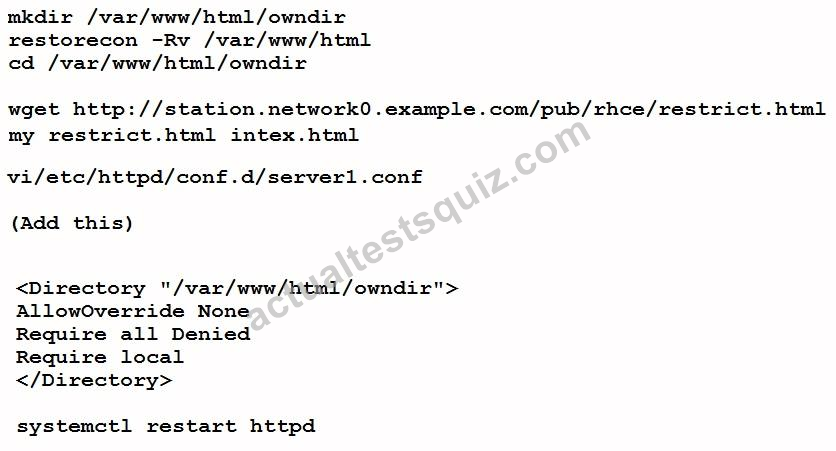
Webpage content modification.
Implement website for serverX.examp">http://serverX.example.com/owndir
Create a directory named as "owndir" under the document root of webserver Download station.network0.example.com/pub">http://station.network0.example.com/pub/rhce/restrict.html Rename the file into ondex.html The content of the owndir should be visible to everyone browsing from your local system but should not be accessible from other location
Correct Answer:
Viewing page 1 out of 18 pages.
Viewing questions 1-5 out of 88 questions.
 Luther
Noel
Ronald
Valentine
Amelia
Christine
ActualTestsQuiz is the world's largest certification preparation company with 99.6% Pass Rate History from 67295+ Satisfied Customers in 148 Countries.

Over 67295+ Satisfied Customers

Our Clients













We only sell the latest, valid and accurate exam questions and answers to our worthy customers because we want to stick to the company ethical more than to earn money without principle. And your success is 100% guaranteed with our high pass rate as 98% to 100%.
Contact Us
From Monday to Saturday
Support: Contact now
If you have any question please leave me your email address, we will reply and send email to you in 12 hours.
Copyright © 2026 ACTUALTESTSQUIZ.COM. All rights reserved. All trademarks are the property of their respective owners and we don't provide actual questions from any vendor. Privacy Policy